

Picture this: you’re gearing up for a committing alpine ridge traverse. Cold granite bites your fingers as you eye the route ahead, full of gritty cracks and uncertain lines. You grab a few wild country hexes because they save weight and nail spots where cams just won’t bite.
Wild Country hexes, also known as Rockcentrics, are big passive nuts shaped like hexagons. Their curved faces nest into tapering cracks for solid protection without springs or moving parts. Climbers still rack them today because they’re lighter than cams, cheaper, and perfect for irregular rock on long routes.
In this post, you’ll learn exactly what these hexes do best. We’ll cover how to pick the right sizes from #00 to #11, based on crack width. Next, you’ll get step-by-step tips on placing them securely and cleaning them without drama.
We’ll also spotlight where hexes shine, like offwidths and alpine adventures, and where they fall short against modern cams. Finally, build a smart rack that mixes hexes with wires and cams for any trad day. Grab your gear, and let’s get into it.
What Wild Country hexes are, and how they work in a crack
Wild Country hexes count as passive protection. They hold by shape and constriction alone, with no moving parts. You slide them into a crack, tug the sling down, and they bind tight. Most climbers know them as Rockcentrics, the current model from Wild Country’s older Hexentric roots. These pieces shine because they nest into uneven spots where other gear fights.
Rockcentrics protect in two main ways. First, they wedge like a nut in a tight constriction; friction and form do the work. Second, you rotate them so the eccentric shape cams slightly in a flare; a pull on the sling rolls the edges outward for extra bite.
Both methods keep things simple and reliable. Picture a gritty alpine crack: you drop in a #7 Rockcentric at an angle, yank down, and bounce-test it. It sticks because the curved faces and rockers grip the rock.
You set them by finding a constriction wider than the narrow end but snug on the wide end. Tilt it 30 degrees from parallel, then pull the sling.
The rockers, those curved bottom edges, roll into place and constrict the hex. In good rock, it feels bomber. Test by loading in the fall direction; a solid “thunk” means go time. They excel in horizontal cracks or icy granite because nothing walks or slips.
Hexes vs cams and regular nuts: the simple difference
Cams grab fast with spring-loaded lobes. You push them in, and they expand to fit. Nuts stay small and precise, like tapered wedges for pin scars. Wild Country hexes sit in the middle: bigger, lighter for their size, and dead simple.
Consider real cracks. A clean vertical granite splitter takes a cam quick; its lobes bite parallel walls on lead. A thin pod suits a nut; you tap it home in a constriction, and it locks small. But a flared offwidth or pocket? Grab a hex. You rotate it into the irregularity, tug, and the shape cams passively. No springs to freeze, no tiny size limits.
Here’s a quick side-by-side look at how they fit:
Hexes win on weight for long routes. Cams pack more punch in perfect cracks, yet weigh extra. Nuts rule micro spots, but lack range. Pick hexes for the in-between stuff.
Why Rockcentrics feel different from older hexes
Older hexes had flat sides. They jammed okay in parallels, but fought flares and pockets. Rockcentrics change that with a curved, tapered design. Concave and convex faces nest into weird shapes. Rockers on the bottom roll and bind better, so they seat faster in irregular cracks.
This helps in real scenarios. A flared ice chute? The taper and curves fill the void without spinning out. Pockets or shallow seams take them too, because the shape molds to the rock. Many Rockcentrics pair this with a Dyneema sling—super light and strong. It cuts weight, but stays floppy. For overhead placements, grab the body to steady small sizes. The extension stays short, which packs tight on your rack.
In short, Rockcentrics place easier and pull smoother than stiff old-school ones. You feel the difference on sketchy terrain.
Strength and safety basics (in human terms)
Rockcentrics hold strong for their size. Common ones like #8 rate around 10 kN on the main axis; #9 hits 12 kN. That means they catch factor-two falls on good gear in solid rock—plenty for most leads.
But strength ratings tell part of the story. Real safety comes from smart placement. Seat it snug, clip the sling short to the rope, and back it up nearby. Poor rock or bad angle drops the hold. Always test with a firm tug downward.
Most importantly, treat every piece as a team player. One hex rarely solos a pitch; mix them with nuts or cams. Check the label for your size, because smaller ones trade strength for flex and lightness. Place well, and they keep you safe without fuss.
A quick history of Wild Country hexes, and why climbers brought them back
Wild Country hexes started in the 1970s as Hexentrics. Climbers needed light gear for big walls. These passive nuts gripped cracks without cams. Cams came later and pushed hexes aside. But Wild Country hexes stuck around. They offer reliability in ice and dirt. Plus, they cost less and weigh half as much as big cams. Climbers revived them for chossy cracks where springs fail.
Hexentrics ruled through the 1980s. Then Rockcentrics updated the design in the 1990s. Curved faces and lighter metal made them better. You rack them today because they nest into flares and pockets. No moving parts means they hold in snow or mud. In short, they fill gaps cams miss.
From Hexentrics to Rockcentrics: what changed and why it mattered
Old Hexentrics had flat faces and steel bodies. They worked in parallel cracks. But flares spun them out. Rockcentrics fixed that with curved faces. Now they grip uneven rock. Aluminum cuts the weight in half. So you carry more for long pushes.
Slings switched too. Wire gave way to nylon. This makes them easier to clip and extend. No stiff tangle on your harness. Those changes open more spots. You place faster in pods or offwidths. Pull the sling, and rockers bind tight.
Check this side-by-side
As a result, Rockcentrics give you options old ones lacked. Less weight means lighter racks. Easier handling speeds your lead.
Where hexes earned their reputation: alpine, winter, and big routes
Wild Country hexes shine on alpine ridges and winter ice. Cold freezes cam lobes. Dirt clogs springs. Passive gear skips those issues. No parts to jam or ice up. They just wedge in.
Picture a snowy granite chute. You slot a #8 into the taper. It bites because curves fill the void. Big routes demand this trust. Hexes hold factor-two falls there. Climbers rack #6 to #11 for those days.
They last too. Aluminum shrugs off drops. Nylon slings resist cuts. So you get years of use. That beats replacing iced-up cams. Durability adds value on remote pushes.
In addition, they pair well with wires for mixed terrain. Reliability wins in the cold.
A safety note on older recalled Wild Country nuts
Shop smart with used gear. Older Classic Rocks or Anodized Rocks faced no major recalls. Still, inspect for cracks or wear. Deformed shapes weaken holds.
Always check Wild Country’s site for updates. Buy from trusted spots. Test every piece before the route. Good condition keeps you safe. Focus on that, and secondhand saves cash without risk.
Choosing the right Wild Country hex sizes for your rack
You rack Wild Country hexes to cover bigger cracks without extra weight or cost. Sizes 5 to 9 form the sweet spot for most climbers.
They handle hand cracks to pods, rate at 14 kN each, and cost little. A full set weighs under 500 grams yet protects big routes. Add them to cams and small nuts, and you avoid overlap. This setup saves cash and packs light for trad or alpine days.
The most common set: Rockcentrics 5 to 9, and what each size is good for
Most racks start with Rockcentrics 5 to 9. These sizes fit thin hands up to fists and pods. Climbers love them for big cracks on granite or sandstone. Each holds 14 kN, so they catch big falls in solid rock. Weights stay low, from 54 grams on size 5 to 156 grams on 9. You get great value at about $80 to $100 for the set.
For example, size 7 slips into a hand crack. Twist it in a granite splitter on an alpine face, pull the sling, and it binds tight. Size 9 takes a pod; drop it into a flared offwidth on a desert tower, and the curves grip the edges.
Here’s a quick chart on these sizes:
| Size | Color | Weight (g) | Typical Crack |
|---|---|---|---|
| 5 | Grey | 54 | Thin hands |
| 6 | Red | 69 | Hands |
| 7 | Gold | 91 | Wide hands |
| 8 | Blue | 118 | Fists |
| 9 | Green | 156 | Pods, offwidth |
This set covers 80 percent of cracks you meet. Rack doubles of 6 and 7 for runouts.
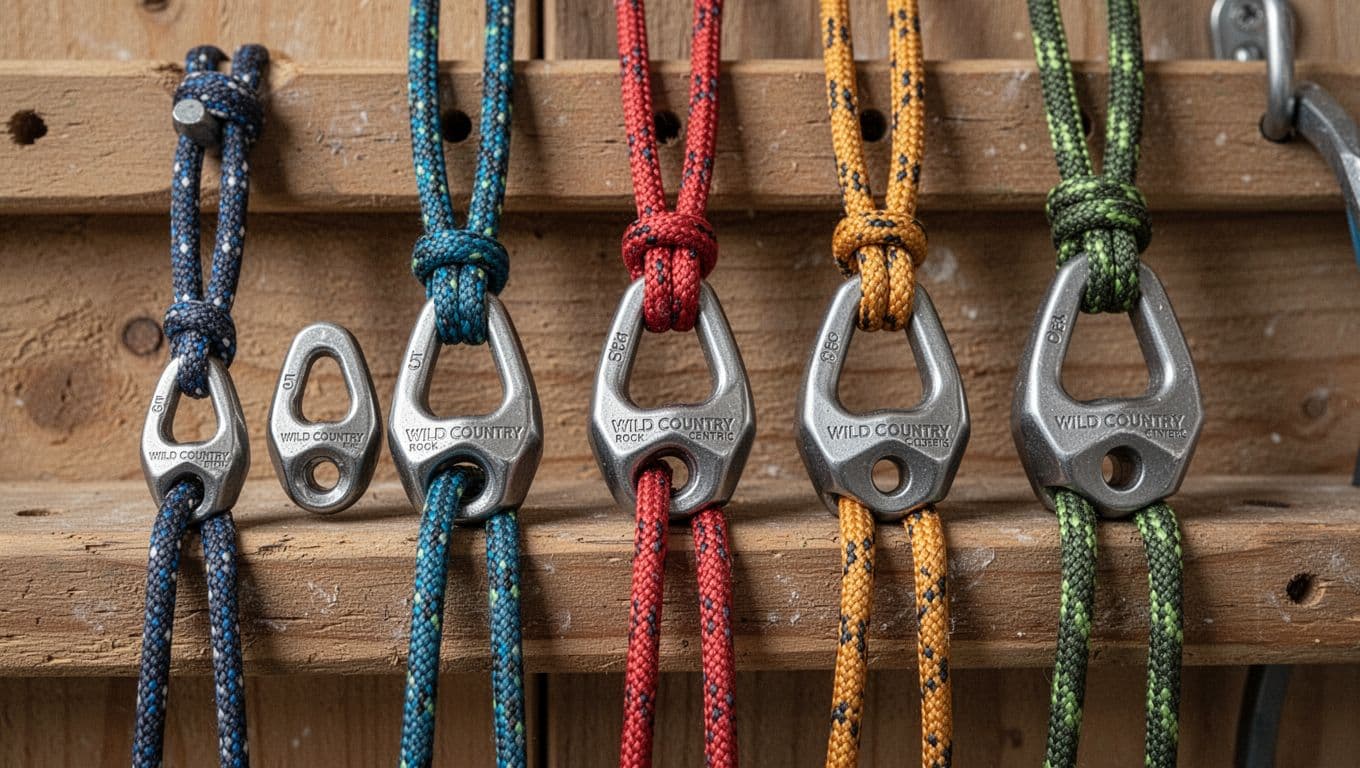 climbing nuts in sizes 5 to 9, arranged from smallest to largest on a textured wooden climbing gear rack. Each nut features a color-coded Dyneema sling, with natural soft indoor lighting highlighting the curved aluminum bodies, tapered shapes, and rockers in high detail."/>
Hexes with wire vs hexes with slings: what changes in real use
Wire gate hexes feel stiff and precise. You push them into overhead spots or thin cracks without flop. They clean fast too, because the wire holds shape. However, they add a bit of weight from the steel cable.
Dyneema slings cut grams and boost strength to 14 kN. They flex to hug edges, so rope drag drops on wandering pitches. Clip the sling direct most times; it bends without extenders. Still, grab a quickdraw for stiff wires or long slings that kink.
In practice, wires shine in winter ice. The cable resists cuts from tools. Dyneema rules alpine racks, because lightness matters on big days. Both place the same way, but slings tangle more on your harness.
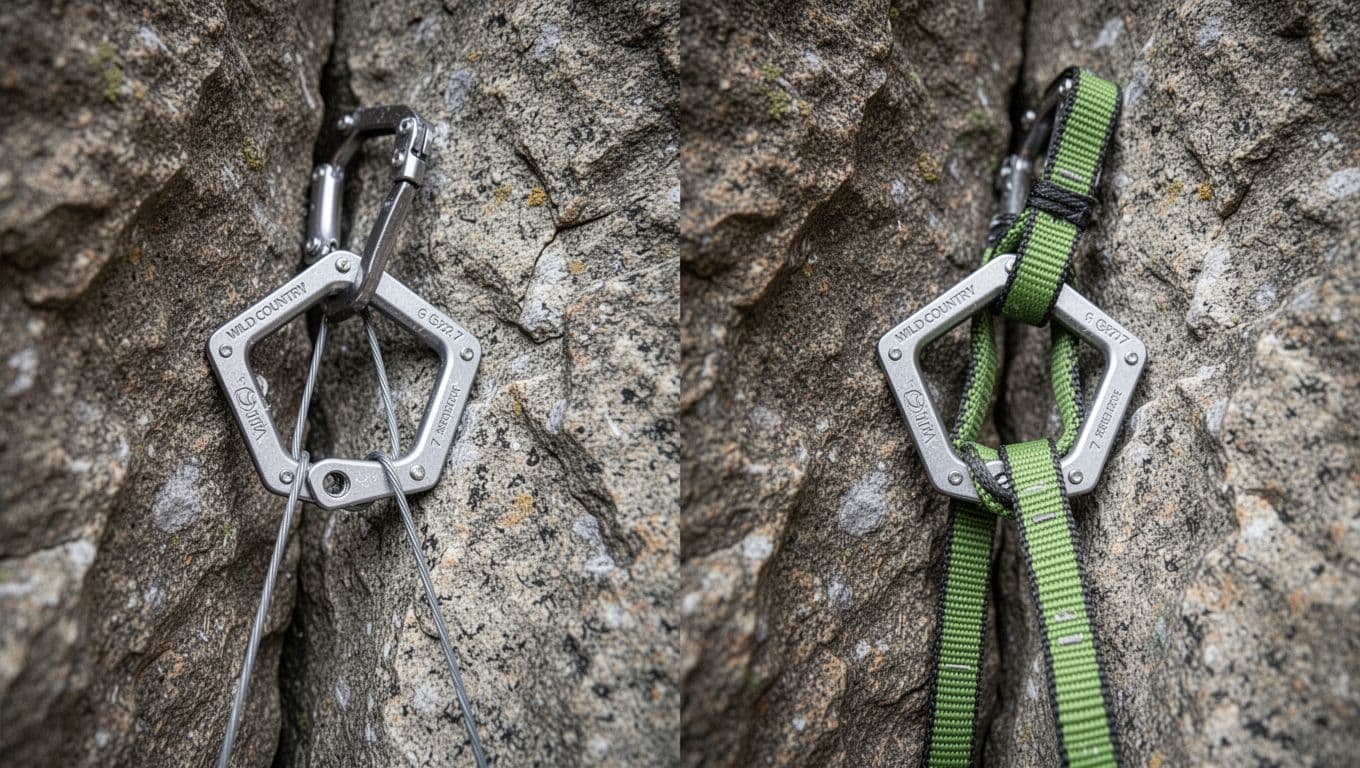
Pick based on your routes. Wires for precision; slings for speed and low drag.
What to pair with hexes so you do not overpack
Pair hexes with small nuts and mid cams to hit all cracks. Skip doubles where sizes overlap. This keeps your rack under a kilo.
For a beginner trad day, rack one set of nuts sizes 1 to 10, Rockcentrics 5 to 9, and four cams in 0.4 to 2. Nuts grab tips; hexes take hands to fists; cams fill middles. Add six draws and a nut tool. Total stays light at 25 pieces.
An alpine rack drops to nuts 4 to 8, four Rockcentrics (5 to 9), and three cams (0.75 to 2). Hexes cover flares without heavy big cams. Toss in two cordelettes for anchors.
A budget rack starts with used nuts 1 to 10 and Rockcentrics 5 to 9. Skip cams at first; hexes replace wide ones cheap. Later, add two mid cams. This setup costs under $200 and protects most single pitches.
These combos avoid fat racks. Test on easy routes, then build out.
How to place wild country hexes so they stay put (and how to clean them later)
You want wild country hexes that lock in and pull clean. Poor spots lead to walks or stuck pieces. Good ones hold falls and come out easy. Follow these steps every time. Then handle tough cracks like flares or horizontals. Finally, learn removal tricks that save time on the sharp end.
The 5-step placement check you can do every time
Run this quick check on every wild country hex. It works in clean granite or dirty alpine chutes. You build confidence fast.
- Spot the constriction. Look for a narrow pinch in the crack. The hex needs room on its wide end but snug fit on the narrow. Skip wide-open flares here.
- Pick the right size. Match the hex so its narrow end slips past the pinch. The wide end should touch both walls lightly. Sizes 5 to 9 cover most hand cracks.
- Try two orientations. Tilt the hex 30 degrees from parallel first. Then rotate it 90 degrees if needed. The curved faces and rockers grab better in one setup.
- Seat it with a firm tug. Slide it in with the flat side against one wall. Pull the sling down hard. Rockers roll and bind. Listen for a solid “thunk.”
- Check pull direction and extension. Bounce in the fall line. It stays put. Clip short to the rope. Long draws let it shift.
Test every piece this way. As a result, you cut bad placements. In icy cracks, wipe dirt first. Then repeat.
Tricks for flares, pockets, and horizontals
Flares, pockets, and horizontals challenge cams. Wild country hexes nest in because of their curves. Rotate for that snug bite.
Start by turning the hex. Use different faces to fill voids. The concave side hugs lips in pockets. Convex grabs flare edges. In limestone pockets, slot against the back wall. Tug down. Curves prevent spin-outs.
For horizontals, think fall line. Place top-to-bottom so rockers face down. Or front-to-back behind a lip. Tapered shape slides easy. Pull the sling along the crack run. It binds across the width.
One caution: avoid outward flares or shallow spots. They lift under load. Back them up with a nut if sketchy. However, in dirty cracks, curves shed mud better than flat nuts.
Practice these on toprope. You place faster on lead. Most importantly, they hold where cams slip.
How to stop hexes from walking, rattling, or lifting out
Hexes walk if loose. Rattles annoy too. Fix it with smart habits.
Place deep first. Push past the first constriction. Extension cuts rope wiggle, so clip the sling short or add a draw. Avoid “barely wedged” spots; they lift on falls.
Rattles come from poor seats or loose slings. That’s the “cowbell” clank on runouts. Tape slings lightly or rack tight on your harness. It quiets them without bulk. Noise stays a comfort thing, not safety.
In wet cracks, dry the spot. Then seat firm. Deep holds resist ice buildup. Still, test hard. If it shifts, yank and retry.
You prevent most issues upfront. Therefore, your rack stays quiet and solid.
Cleaning a stuck hex without a fight
Stuck wild country hexes waste energy. Clean smart to avoid fights.
Unweight the sling first. Bounce on the rope lightly. Then reverse your placement rotation. Twist opposite the cam direction. Lift one edge up. Slide it out along the taper.
Use a nut tool carefully. Hook the sling, not the body. Pry gently side-to-side. Never yank straight down; it binds tighter.
For cold hands or gloves, warm the tool in your pocket. Grip stays sure. Wiggle more, pull less.
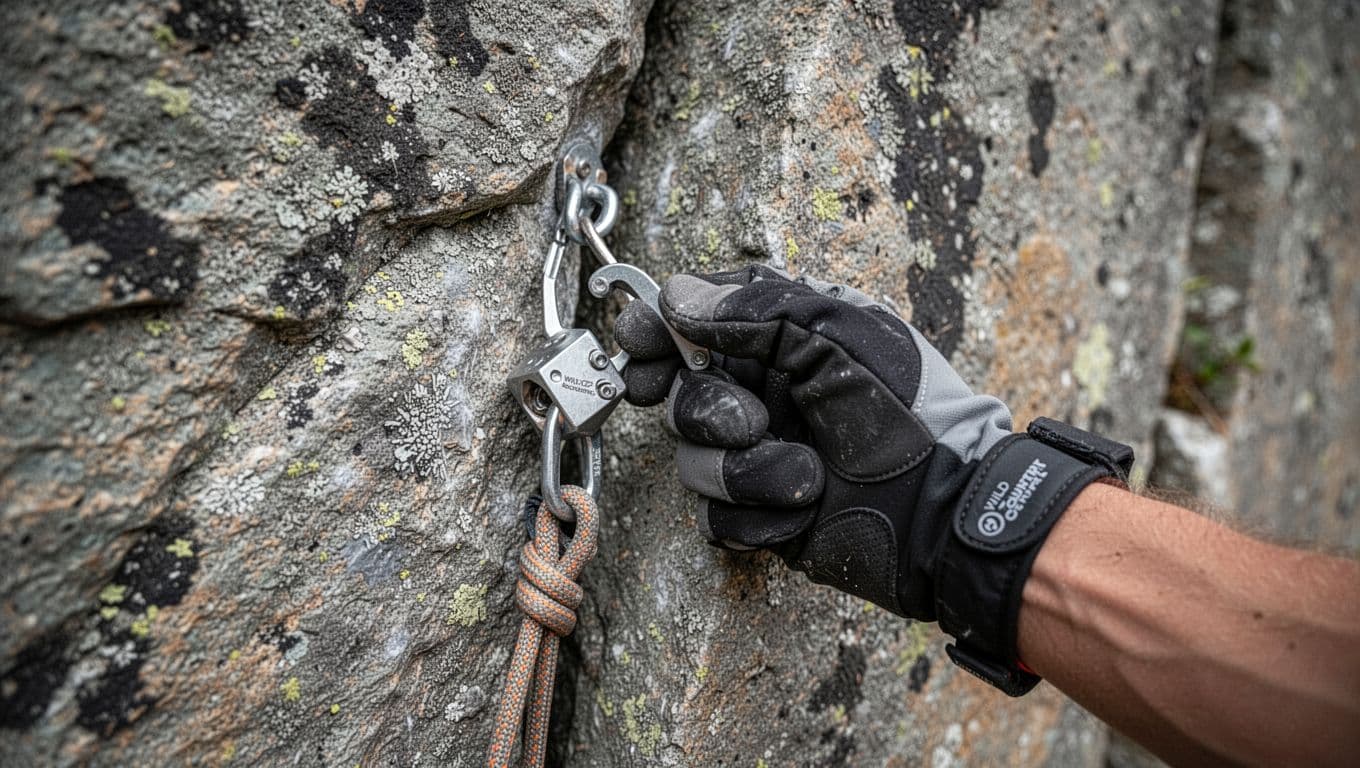
Curves make removal easier than old hexes. Practice on plastic walls. You save slings and fingers that way.
Where hexes beat other gear, and where they are the wrong tool
Wild Country hexes save your rack in spots where cams get heavy or nuts fall short. However, they flop in perfect cracks or tiny seams. You decide based on the rock, route length, and your speed needs. Cost stays low at half the price of cams, and weight drops too. Still, placement takes practice. So, reach for them first in irregular terrain. On the other hand, grab cams or nuts when cracks run parallel or tight.
Best places to use Wild Country hexes
Big cracks call for hexes over bulky cams. You skip the weight of a #4 Camalot, which packs 300 grams, while a size 9 hex weighs just 156 grams. For example, on a desert offwidth, drop in the hex. It nests cheap and light.
Limestone pockets suit them too. Twist a size 6 into the weird shape. Curves hug the lip better than stiff cams. As a result, it grips without expanding lobes.
Flared cracks work when snug. Rotate the hex so rockers bite the edges. Pull the sling, and it cams passively. Cams walk out here; hexes stay put.
Cold or dirty placements favor passive gear. Ice freezes springs, mud clogs cams. However, hexes wedge clean. Wipe the spot, slot it in, and test. They shine on alpine routes like snowy Cascades chutes.
Long routes love simple pieces. No moving parts means reliability on multi-day pushes. Rack five hexes instead of three big cams. You save ounces for the summit.
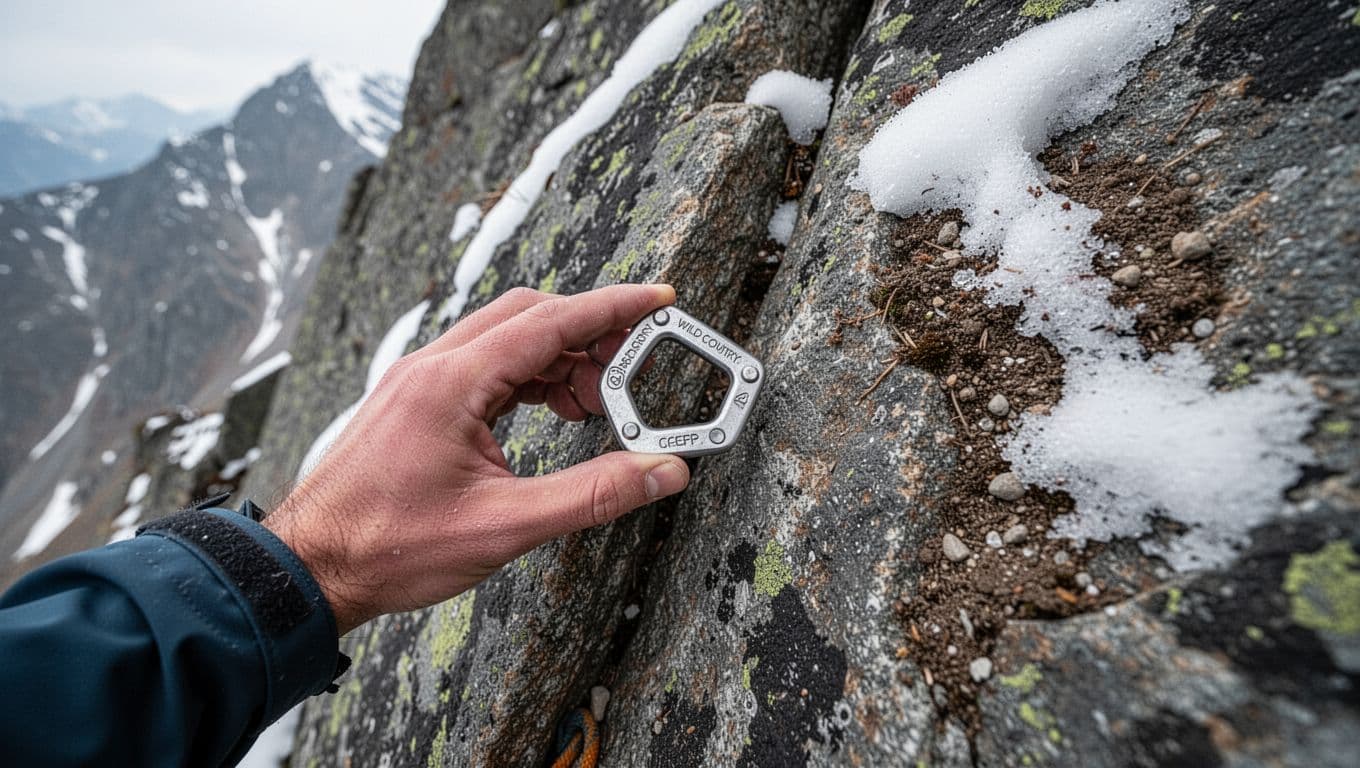
In short, hexes beat other gear in these niches. They cut cost and weight without fuss.
When a cam or a smaller nut is the smarter choice
Perfect parallel cracks scream for cams. You push in a #1 or #2 fast; lobes expand and hold. Hexes take longer to rotate and tug. Speed wins on sporty trad leads.
Tiny placements need small nuts. Sizes under #5 constrict tight where hexes bulk out. For example, a finger crack takes a #3 Rock, not a hex #00. Nuts weigh grams less too.
Situations where speed tops savings pick cams. Busy crags or gym-to-crack transitions demand quick clips. Hexes jangle and slow you down. Besides, poor seats rattle out on crumbly sandstone. They shift under bounce tests there.
On slick granite, cams bite parallel walls better. Hexes need irregularities to lock. So, back them up anyway. Nuts pull easier from flares on limestone, because tapers scoop in.
Therefore, skip hexes in clean, fast cracks. Tradeoffs favor active gear then.
A quick comparison to stoppers and other popular nuts
Stoppers and Wallnuts rule small to medium constrictions. They taper precise for pin scars or tips. Weights stay tiny, from 20 grams up. You rack a dozen cheap.
Hexes handle larger, weirder pods and flares. Size 5 fits hand cracks; nuts top out smaller. Curves fill voids where flats spin. However, hexes weigh more per size.
Some climbers carry both because nuts grab micro spots, hexes cover fists and offwidths. For example, pair Wild Country Rocks 1-10 with hexes 5-9. This hits every crack without gaps
In contrast, hexes add passive backup for alpine days. Nuts teach skills first. Mix them smart, and your rack flows.
Conclusion
Wild Country hexes stand out as passive protection pieces shaped like hexagons. Their curved faces and rockers let them nest into tapering cracks, flares, and pockets where cams struggle or nuts fall short. Rockcentrics, the modern take, grip irregular rock better than older flat-sided versions because of that tapered design. Climbers rack them today for alpine routes, winter ice, and big walls. They save weight, cost less, and hold strong at up to 14 kN in sizes like 5 to 9.
Most folks start with sizes 5 to 9. These cover thin hands to fists and pods on granite or sandstone. For example, a size 7 fits hand cracks perfectly; size 9 tackles offwidths without bulky cams. Pair them with small nuts and mid cams to build a light rack under a kilo. You avoid overlap and stay ready for any trad day.
Placement keeps them secure. First, find a constriction. Next, tilt at 30 degrees, tug the sling down hard, and bounce test in the fall line. Rockers bind tight then. Clean by unweighting and twisting reverse. These habits prevent walks or stuck pieces.
Recent reviews confirm Rockcentrics shine in tough spots. Climbers praise their lightness over cams and grip in crumbly or icy cracks. No big changes hit in 2026; they remain a timeless pick for smart racks.
Back to Climbing Nut Reviews
Recommended Climbing Products
These products can support safer climbing, belaying, rappelling, and emergency readiness.
Affiliate disclosure: As an Amazon Associate, TradClimbers may earn from qualifying purchases at no additional cost to you.
Keep exploring helpful trad climbing, gear, safety, and technique resources.
- A Climber’s Guide to Rock Climbing in Thailand
- A Trad Climber’s Guide to the Isle of Skye Ridge
- Hueco Tanks Rock Climbing: hueco tanks rock climbing Essentials
- A Climber’s Guide to The Nose of El Capitan
- The Top 8 Unforgettable Climbing Routes El Capitan Has to Offer in 2026
- Yoga for Climbers: Boost Strength, Flexibility, and Recovery | yoga for climbers